












It’s that time of year where the Hmong community comes together, where memories are made, and friendships begin. The small ethnic group refers to the event as Noj Peb Caug, which means “eat thirty.” They say that because three days that the event is held on, there are at least 10 vendors on each day. Hmong New Year is a time for the Hmong people to remember and celebrate their ancestors; it is also a time to celebrate family member’s journeys to freedom from the war in Laos.
After living in China for over 4,000 years, the Hmong were forced to escape persecution from an expanding Chinese empire. They moved to Laos, Thailand, Vietnam and Burma. In the 1960s, the Hmong were involved in the Secret War; the United States secretly hired the Hmong to fight with the United States against the North Vietnamese and Laotians in the Vietnam War. After the war, the United States left Vietnam and the Hmong. The North Vietnamese and Laotians killed thousands of Hmong, forcing them to flee Laos and cross the dangerous Mekong River to refugee camps in Thailand. Starting in the 1980s, the Hmong began moving from the refugee camps to Wisconsin, Minnesota and California. Many were sponsored by relatives already living in the United States.
The New Year celebration shows the amazing traditional clothing which elaborates on the stitching and bright colors reflecting on their journey to escape Laos. With the traditional clothing, they also wear a necklace that is called “xuav”. On the xuav, there are symbols that represent love, spirituality, ancestors, and nature.
The event is filled with dancing, music performances, game tournaments, and a good game of ball toss. Ball toss is a game that has been around for decades. The girls and boys form two separate lines; the girls toss the ball to the boy that they like. If a boy or girl drops the ball, then they must give the other player an item they are wearing. It connects to further meetings in order to receive the items back resulting in having a relationship.
The volleyball teams showed their effort and focused intensity during each game. Players made sure that their opponents saw how determined they were through powerful spikes, defensive dives, and their coordinated teamwork. For many teams, this is more than just a game, it is a showcase of showing their athletic skills and an opportunity to represent their community with having a strong sense of pride and competitive spirit. Every point was fought hard, reflecting the high stakes and also the respect the players have for the sport and the other teams.
Hmong music performances are an expressive part of cultural celebrations. They often add in traditional instruments that carry history and emotions. The Qeej is a Hmong instrument that consists of 6 bamboo pipes of different sizes. It is the most played instrument that is played in ceremonial events, storytelling, and during festivals. The sound blends chords and melody which mimics bird calling and human speech. It is essential in funerals where it guides the spirit. In most Hmong New Years, they would have the Hmong celebrities come and sing for the audience but unfortunately there was none that were able to come this year. People from the community volunteered their vocal talents.
Hmong dancing is characterized by its grace, formation, and the visuals they prepared. Everyone did an amazing job at keeping their pace together; they truly showed why they came to the New Year! Their movements were gentle and flowy, their steps were in sync, so were the arm movements, and their rhythm with the swaying portrayed the elegance that Hmong dancing had decades ago. Their dance serves as a beautiful visual for sharing cultural identity.
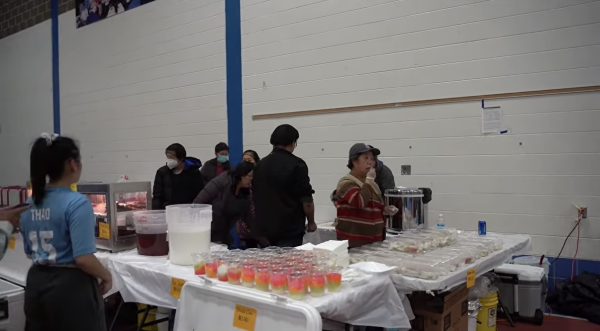
Beyond all the wonderful performances and games, the event was, yet again, a great successful year! The booths of food and items were spectacular and fun. One jewelry booth had hidden small bells around the gymnasium and if someone found the bells, they won one free jewelry, and that was super fun for those who wanted to participate. This New Year felt more special and meaningful because of the connections that were brought and because more people from outside of the Hmong community came to support the celebration.